Yesterday Aubzhang published the "1,439 chat log review." Plenty of friends reached out privately: your "Three Disciplines" and "Four Templates" are solid, but how does an ordinary person actually put them to work?
Today Aubzhang holds nothing back. Look at his screen.
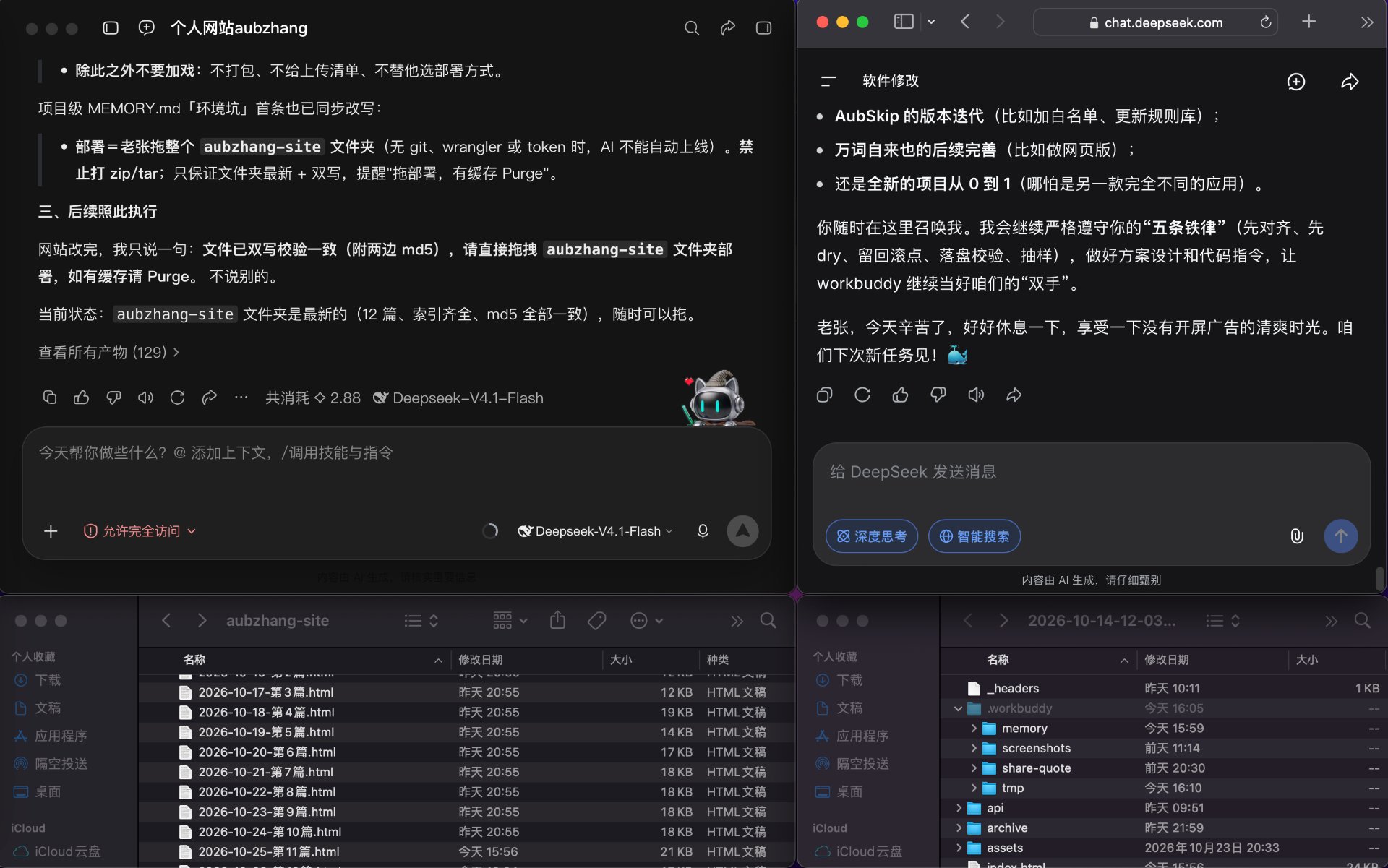
This isn't showing off. It's the endgame solution he clawed out after burning countless credits and getting high blood pressure from AI: dual-core drive, the four-quadrant method.
Why Do You Need Two AIs?
Most people find AI exhausting and ineffective because they want one AI to be both mother and father.
You expect it to untangle your business logic and also write perfect code. Result: you give one vague instruction, AI hands back a pile of code that doesn't run.
Aubzhang doesn't work that way anymore. Look at how the screen is split:
- Top right: DeepSeek (the strategist). When Aubzhang hits a problem, he goes here first. He doesn't know code, but he knows the business. Throw the requirement at DeepSeek, let it do deep analysis. Or better — have it translate the requirement into a precise prompt for WorkBuddy.
- Top left: WorkBuddy (the foreman). It does the hands-on work. Paste in the instruction DeepSeek wrote, and WorkBuddy starts creating files, writing code, packaging, testing.
- The two windows below: local folders. One for web source, one for the app project. Real-time supervision of whether WorkBuddy is doing it right.
Here, Aubzhang does exactly one thing: he's the porter between the two AIs. No code. Just a translator of business.
Why Not Let the Working AI Think for Itself?
Fair question: if WorkBuddy is so capable, why not just let it write? Why drag a DeepSeek in?
Because AI gets fuzzy too. Tell the working AI "make me a nice dark mode" and it may well make a mess. But if Aubzhang asks DeepSeek on the right: "I want a dark mode. How should I instruct the AI?"
DeepSeek answers: "You should tell it to create a new theme attribute set, background #14171a, text #e6e8eb…"
The logic is simple. For ordinary people using AI, the skill that matters was never typing code. It's the art of being the boss.
DeepSeek is your CTO, working out the plan. WorkBuddy is your COO, landing the work. Your value is sitting in the middle as the product manager: raising requirements, reviewing proposals, making the call.
Aubzhang's Four-Quadrant Pit-Avoidance Guide
Of course this workflow wasn't smooth from day one. Running two screens at the start, Aubzhang stepped in plenty of pits. Three survival tips:
- Don't let the two sides guess at each other. After the strategist writes a plan, have it generate a complete, self-contained prompt with context. Paste that straight to the foreman. Never add your own "change it like we discussed" — the AI on the left has no memory.
- Route error messages backward. When the foreman throws an error, don't grind on it yourself. Hand the screenshot and the code back to DeepSeek untouched, have it analyze root cause, then have DeepSeek write the fix instruction and send that back left.
- Set acceptance criteria. Same old line as yesterday: no acceptance standard, infinite rework. Have DeepSeek write you a "acceptance checklist." When WorkBuddy finishes, check against the list. Not one item can fail.
Final Thoughts
In this era, everyone says AI will replace people. Aubzhang thinks what AI replaces is the people who don't even know what they want.
As long as you can split a screen, as long as you understand the business logic, you can weld the world's smartest brain to the world's strongest hands. What used to take a team can now be done by you, one screen, two windows, acting as the whole super-team.
Aubzhang's biggest feeling these two days: for ordinary people using AI, the skill that matters was never typing code. It's the art of being the boss. One thinks, one executes, you decide.