When you build projects with AI, you've probably hit this maddening moment: more and more projects, code and documents scattered across local folders. Two months later you want to pick up where you left off, and forget finding the file — you can't even recall the logic you were working with.
Worse, when you send a requirement to AI expecting it to work, AI acts like a tool with no memory. It has no idea what you did in the last step.
Today Aubzhang shows his hand: how he uses WorkBuddy's Library feature to turn scattered experience into digital assets he can summon anytime.
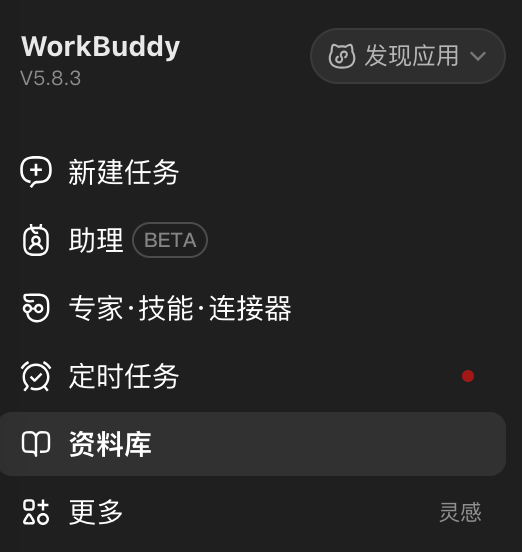
Open WorkBuddy and find "Library" in the left navigation. Plenty of people only ever click "New Task" and overlook this critical asset-deposit area.
Why Cloud Instead of Local?
Most people keep materials on their own computer. But local has a fatal weakness: it's dead data. Unless you actively open it and actively send it to AI, AI simply cannot see it.
Aubzhang keeps materials in the cloud library for two core reasons: one, it can be summoned by AI at any time; two, multiple projects stay manageable.
Look at his library overview and you'll get it.
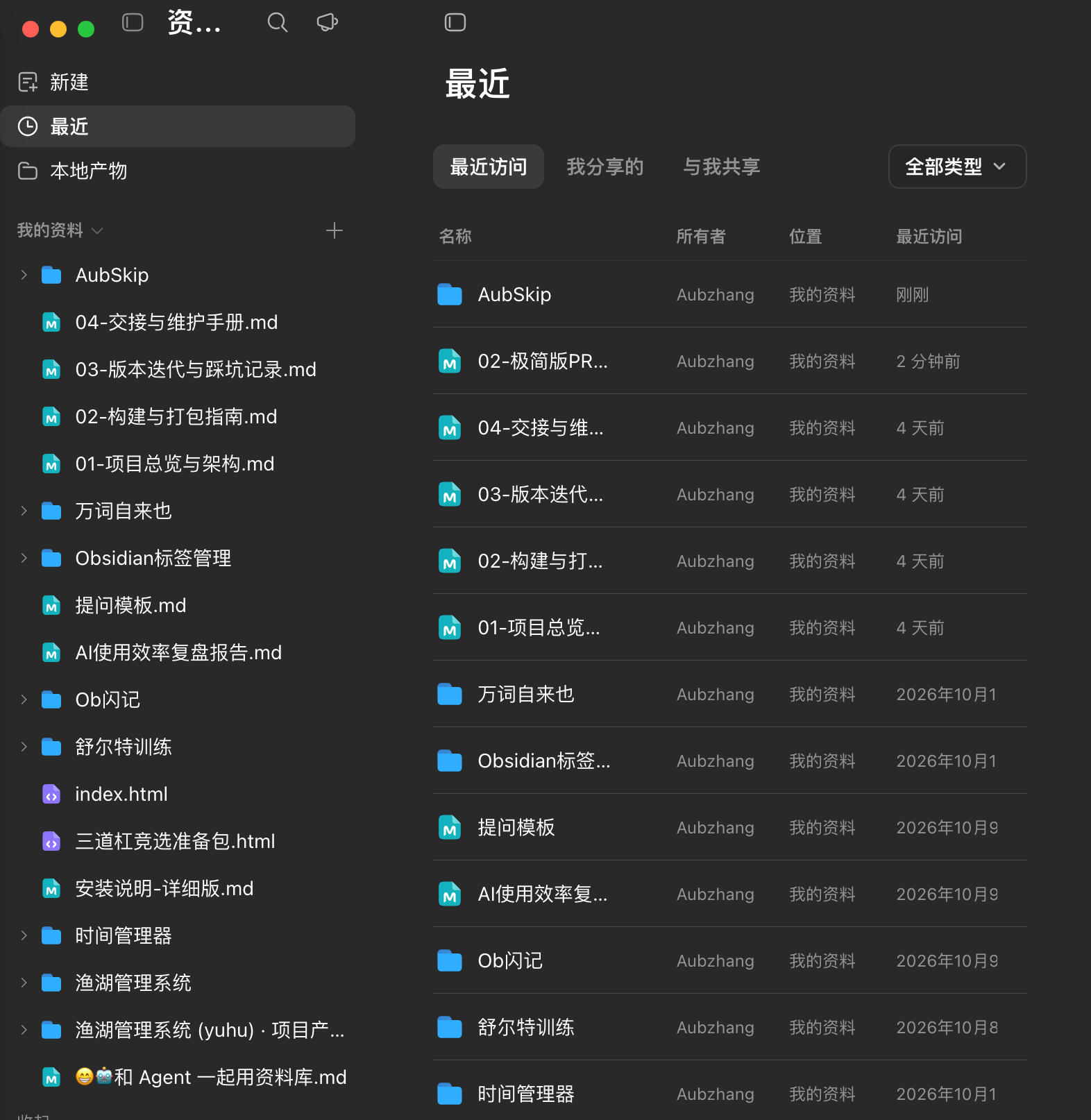
Inside are neatly separated folders: "AubSkip," "Wanci Zilaiye," "Time Manager," and even the "Prompt Templates" and "AI Usage Efficiency Review" from earlier episodes. Down in the bottom left: he's using 325.98 MB of cloud space.
The benefit: whether he's writing an article or having AI change code, these materials can be pulled precisely. They're no longer dead files lying on a hard drive.
Aubzhang's Method: Understand Both Humans and AI
Storing is only step one. Managing is the real craft. Look at the AubSkip project folder.
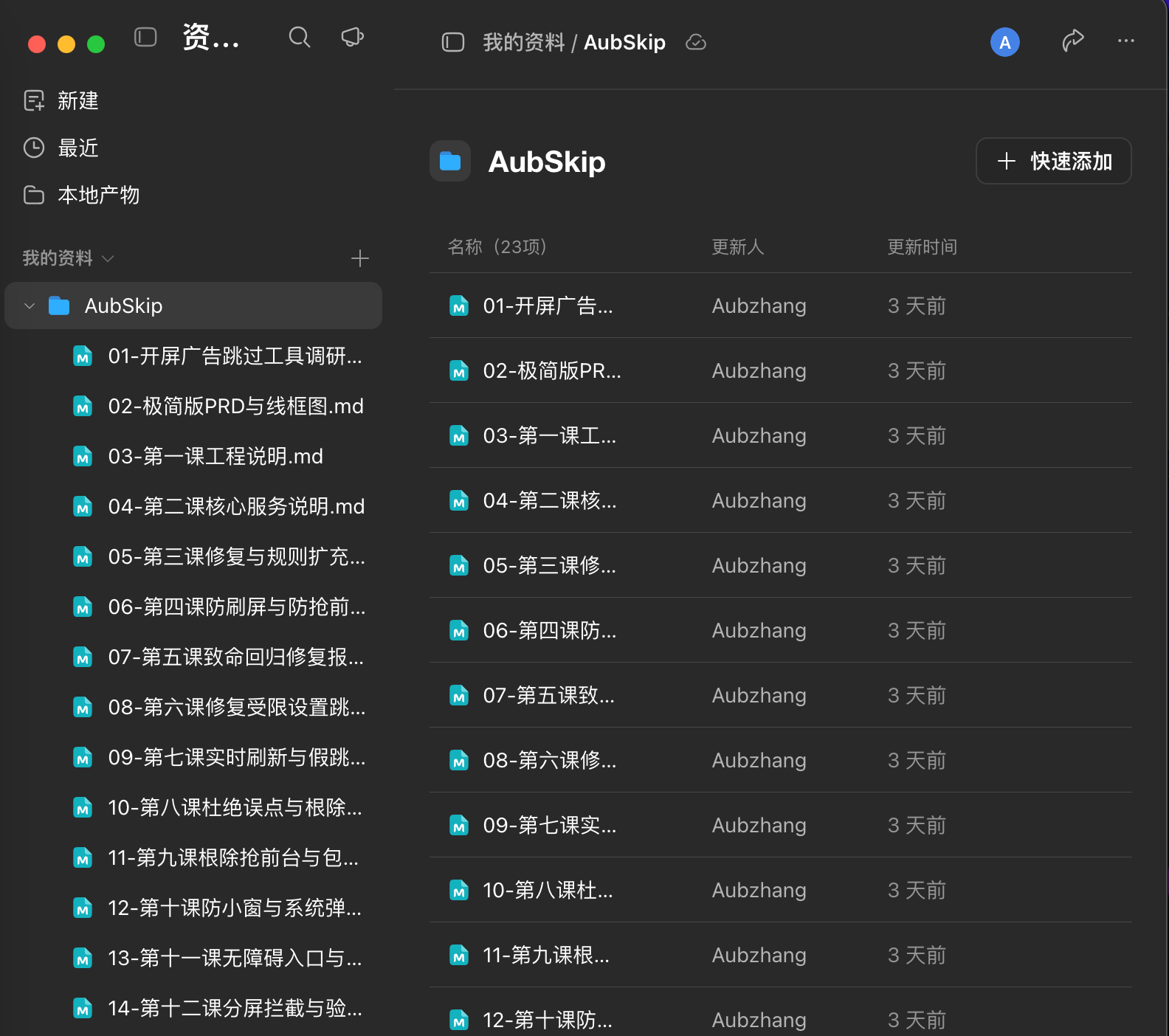
Note the naming convention:
From 01-开屏广告跳过工具调研, 02-极简版PRD与线框图, through the core service documentation, the anti-flooding logic, the critical regression fix report… 23 documents in all, every one starting with a number plus Markdown (.md) format.
Why so fussy?
- For humans: one glance and the iteration history of the project is obvious. Always in order, never a mess.
- For AI: AI is extremely sensitive to Markdown. When Aubzhang asks AI to "fix the foreground-hijacking bug," AI scans the directory and lands instantly on
11-第九课根除抢前台.... That's the extreme efficiency that disciplined deposits buy.
What You Deposit Isn't Text — It's Context
If all you do is create a text file with two sentences, that's a memo, not a library. Look at how Aubzhang writes documents.
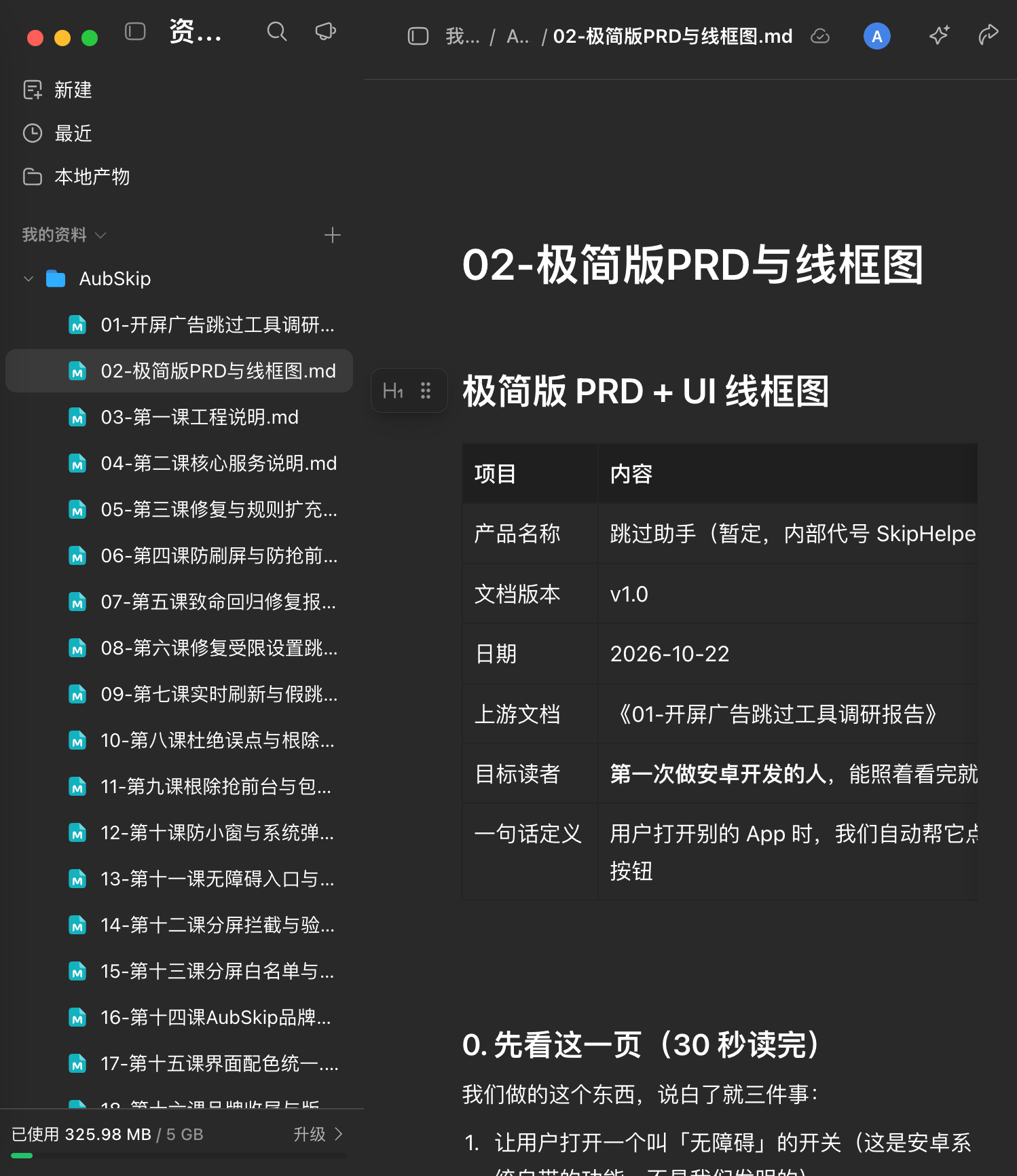
This is his "02 — Minimal PRD and Wireframes." It includes document version, date, upstream document link, target readers. Most important, he wrote a one-line definition: When the user opens another app, we tap the button for them automatically.
Why go to that trouble?
Because when you later need AI to extend a feature, you hand it this document and AI instantly understands your product philosophy, your boundaries, your context. You don't even need a long prompt. A good deposit document beats a thousand words.
One-Click Wake-Up: The Library's Real Power
Everything so far was about storing. So how good is it in use? Here's a real case.
Say Aubzhang wants a big optimization pass on AubSkip. He doesn't need to re-narrate the background at length. He just types this when creating a new task:
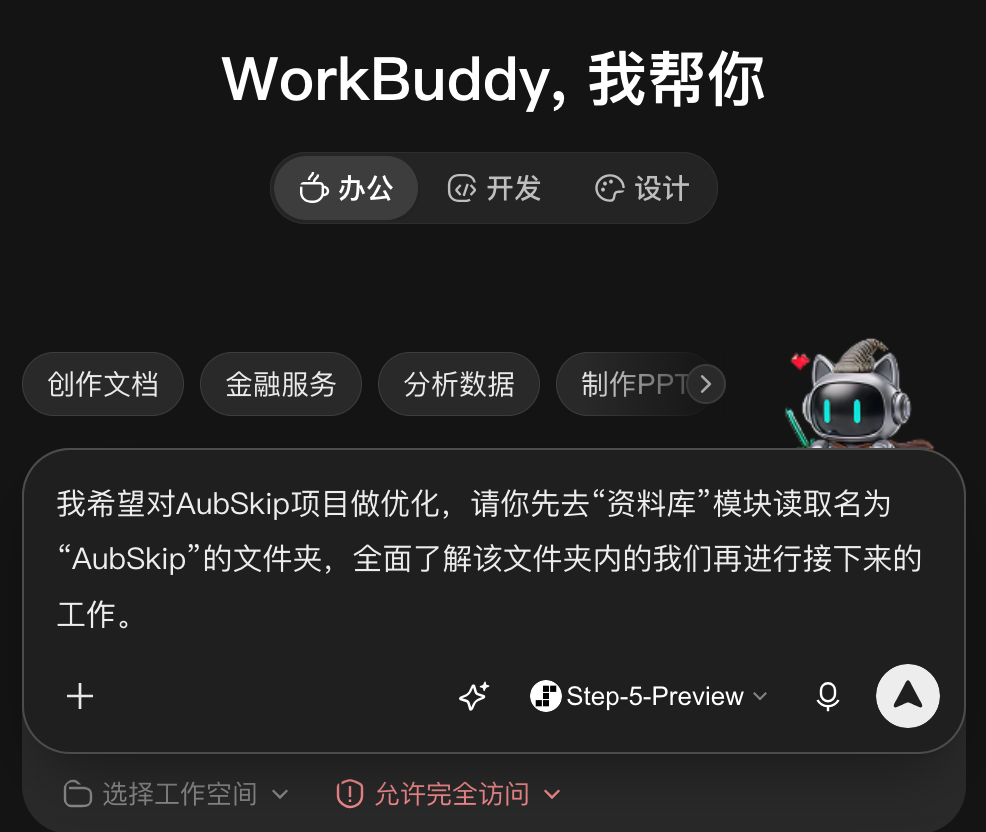
"I want to optimize the AubSkip project. Please first go to the 'Library' module and read the folder named 'AubSkip', get a full picture of the documents inside, then we'll continue."
Send that, and WorkBuddy rummages through the cloud storehouse like it's been unlocked.
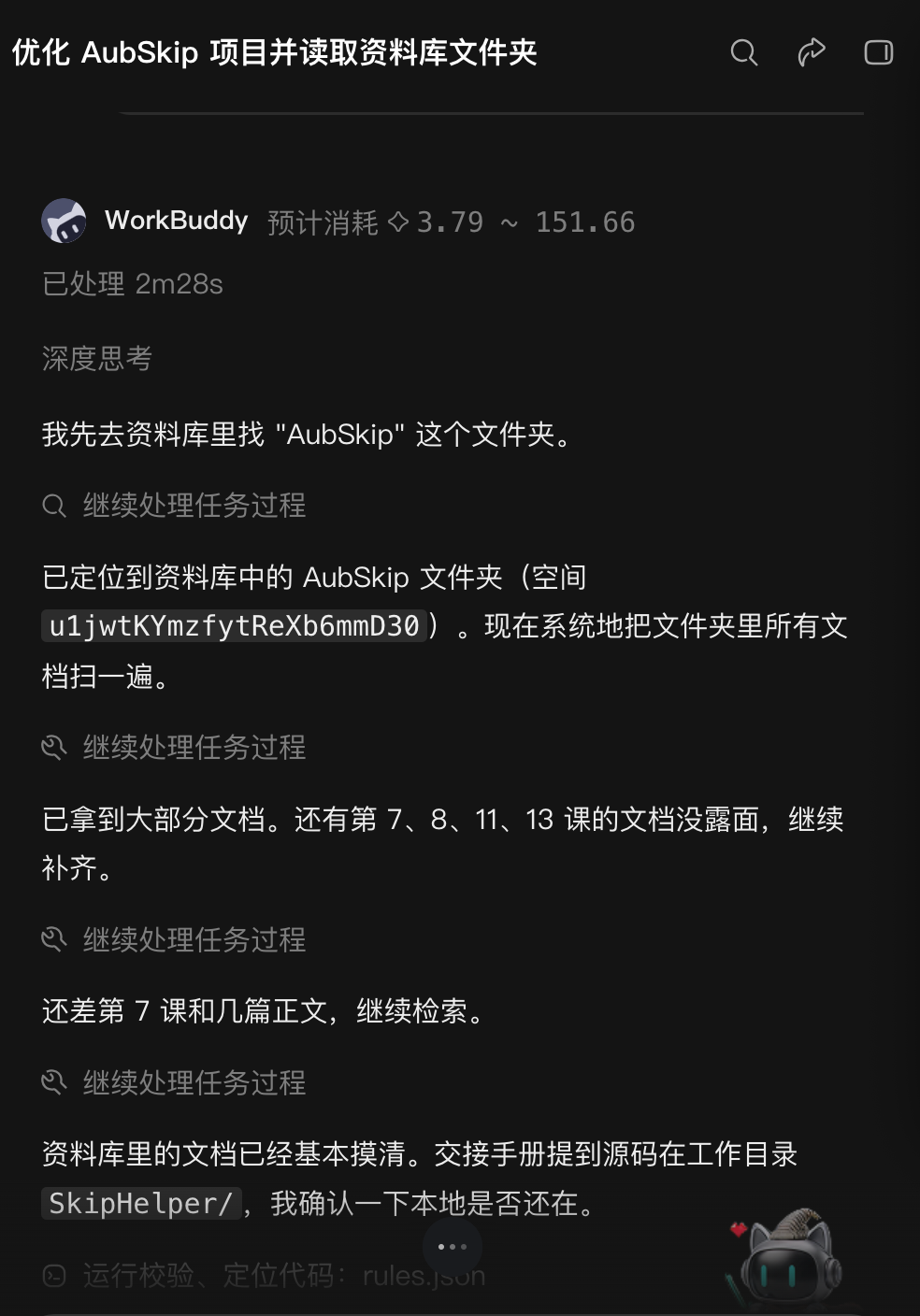
Look at the execution: it located the AubSkip folder precisely and systematically scanned every document. When it noticed documents for lessons 7, 8, 11, and 13 were missing, it went back and retrieved them on its own. In the end it not only absorbed the docs but, following a hint in the handover manual, located the local working directory SkipHelper/ and got ready for code.
That's the real charm of a library: you give one direction, and AI brings your past experience and memory along, filling in all the context itself.
Final Thoughts
Aubzhang built all this because he believes one thing: depositing project materials in a structured way isn't just filing. It's building your own external brain.
Lots of people use AI by digging a new hole every day and forgetting it the moment it's done. Over time you realize: what separates people isn't how many prompts they memorized. It's how complete the experience they deposited is.
Give memory to the cloud. Leave context to AI. Keep the thinking for yourself. What really separates you is the experience you deposited. With a library like this, no project is too big to pick back up seamlessly.