These past six months, more and more people around Aubzhang want to build a side hustle on AI.
Some want AI-generated Xiaohongshu posts. Some want AI short dramas. Some want to take orders writing resumes. Short videos everywhere shout: "Learn AI and ten grand a month is no dream."
A dozen years a product manager, Aubzhang has always been wary of that "effortless money" tone. To find out how deep this water really goes, he decided to do something brutal: have AI scrape the whole internet and produce a deep, dozen-page industry research report.
This time Aubzhang got the truth, and got schooled.
Round One: Feeding the Idea to AI
Aubzhang typed the first instruction, natural as anything:
"You are a senior business analyst. Please produce a deep market research report on 'The Real AI Side-Hustle Tracks for Ordinary People in 2026.'
Requirements:
1. Use live web search. Pull the latest industry data. Do not fabricate.
2. Analyze the three core pain points in the current market.
3. Give the two most promising AI side-hustle directions for 2026.
4. Finally, summarize the core data in a Markdown table and give one concrete execution recommendation."
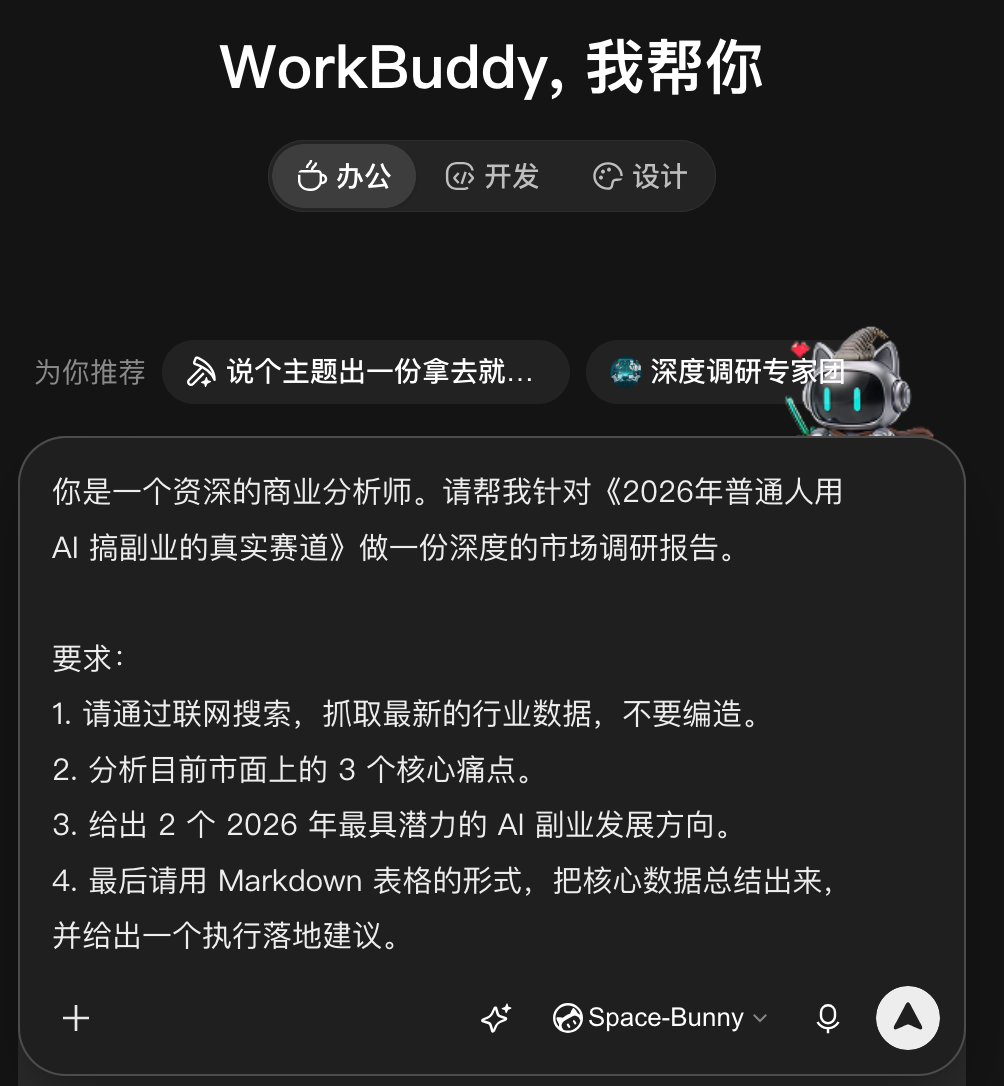
Enter pressed, Aubzhang expected it to lift a few WeChat articles off the web and fob him off. Instead it actually pulled financial reports and official data from major platforms (Xianyu, Upwork, DataEye) and came back with hard conclusions.
Truth number one: demand is exploding, and the people taking orders are starving.
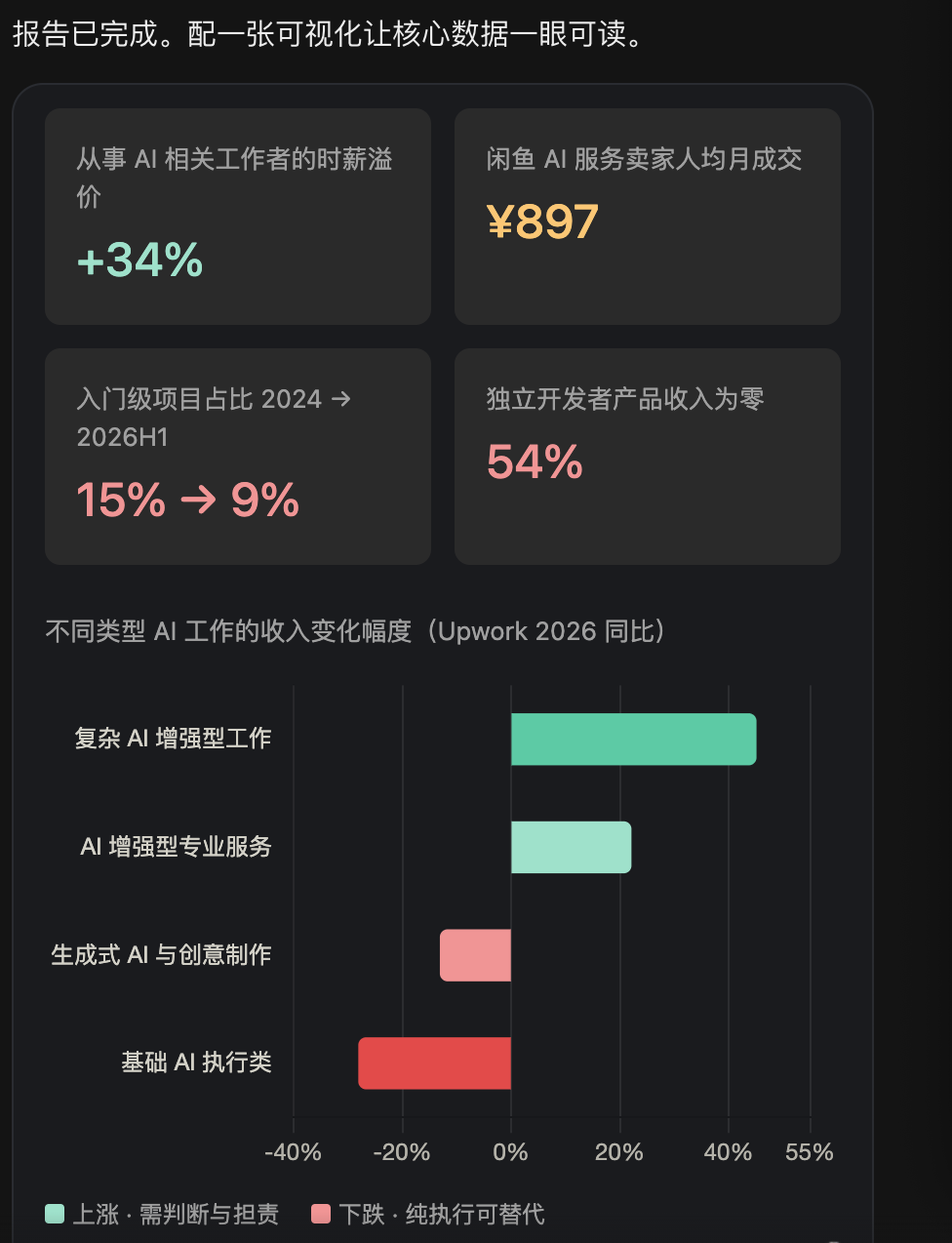
Aubzhang stared. AI service orders on Xianyu are up 157%. Looks like a huge opening, right? But in the same official dataset, AI sellers average 897 yuan of monthly transaction value. And on Upwork, the international freelance platform, entry-level projects went from 15% of the market to under 9% in two years.
Truth number two: you think you're earning. You're working for the platform.
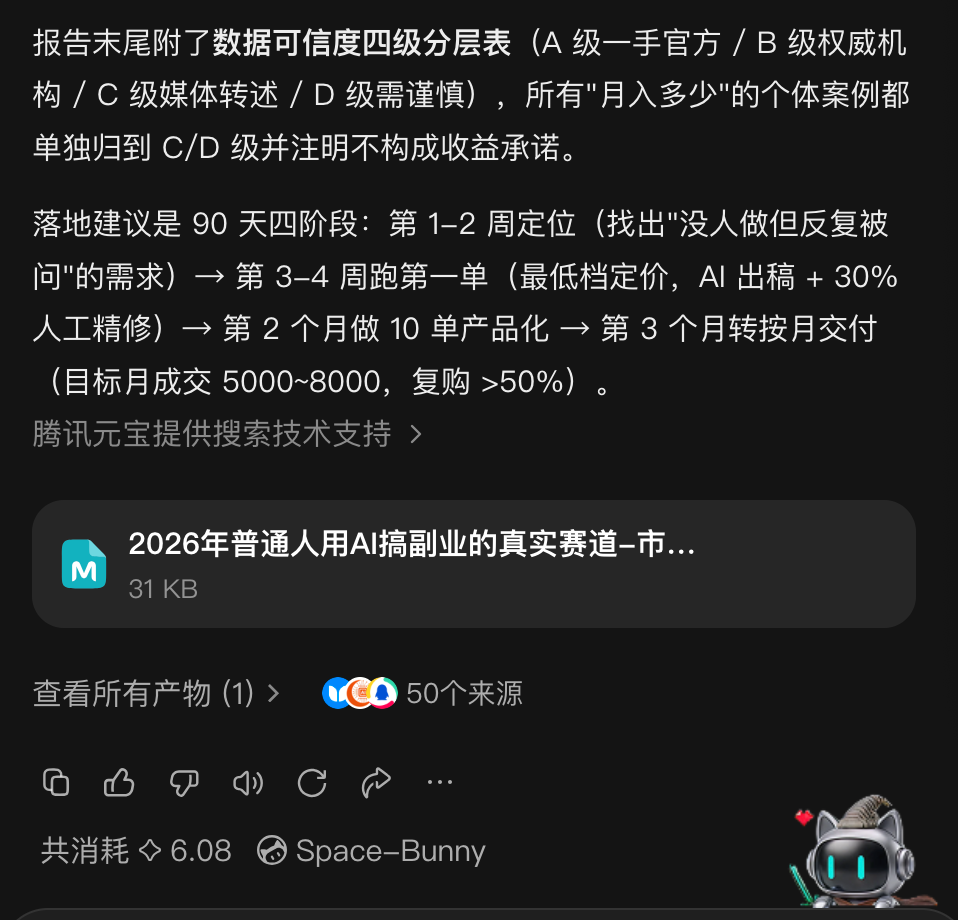
Look at the data it pulled: in the first half of 2026, 220,000 AI short dramas launched across the web. Break-even rate: 1.3%. Roughly 90% of AI short-drama companies are losing money. Production cost down 90%, traffic cost up 100%, revenue down 50%.
That's not a side hustle. That's donating your labor to platforms and compute providers.
Round Two: Aubzhang Raised the Difficulty
After that first stage, Aubzhang wasn't satisfied. However pretty the data, it's too abstract for an ordinary person. Most people don't even know where to find a customer, and you're giving them macroeconomics?
So he upgraded the prompt and started pressing:
"The data volume is solid, but I'm an ordinary person who's going to execute this myself, not an academic writing a research note. To make it genuinely actionable, dig deeper on three extremely concrete operational dimensions and give me a supplement: an 'Execution Landmine Map.'
[Difficulty One: Where's the first mile of customer acquisition?] An ordinary person has zero corporate clients in hand. Give extremely specific, zero-cost cold-start acquisition channels. Which exact neighborhood WeChat group? Which local city forum? Which type of physical storefront to walk into? Get down to the scenario and the script.
[Difficulty Two: A brutal failure autopsy] Assume ten ordinary people really did this, and all ten failed. Play a savage coach. Where did they most likely die?
[Difficulty Three: Make the moat concrete] If an ordinary person picks 'AI customer service for restaurants,' how do they turn that store's industry know-how into a knowledge base AI can understand, within one week? What's the exact workflow?"
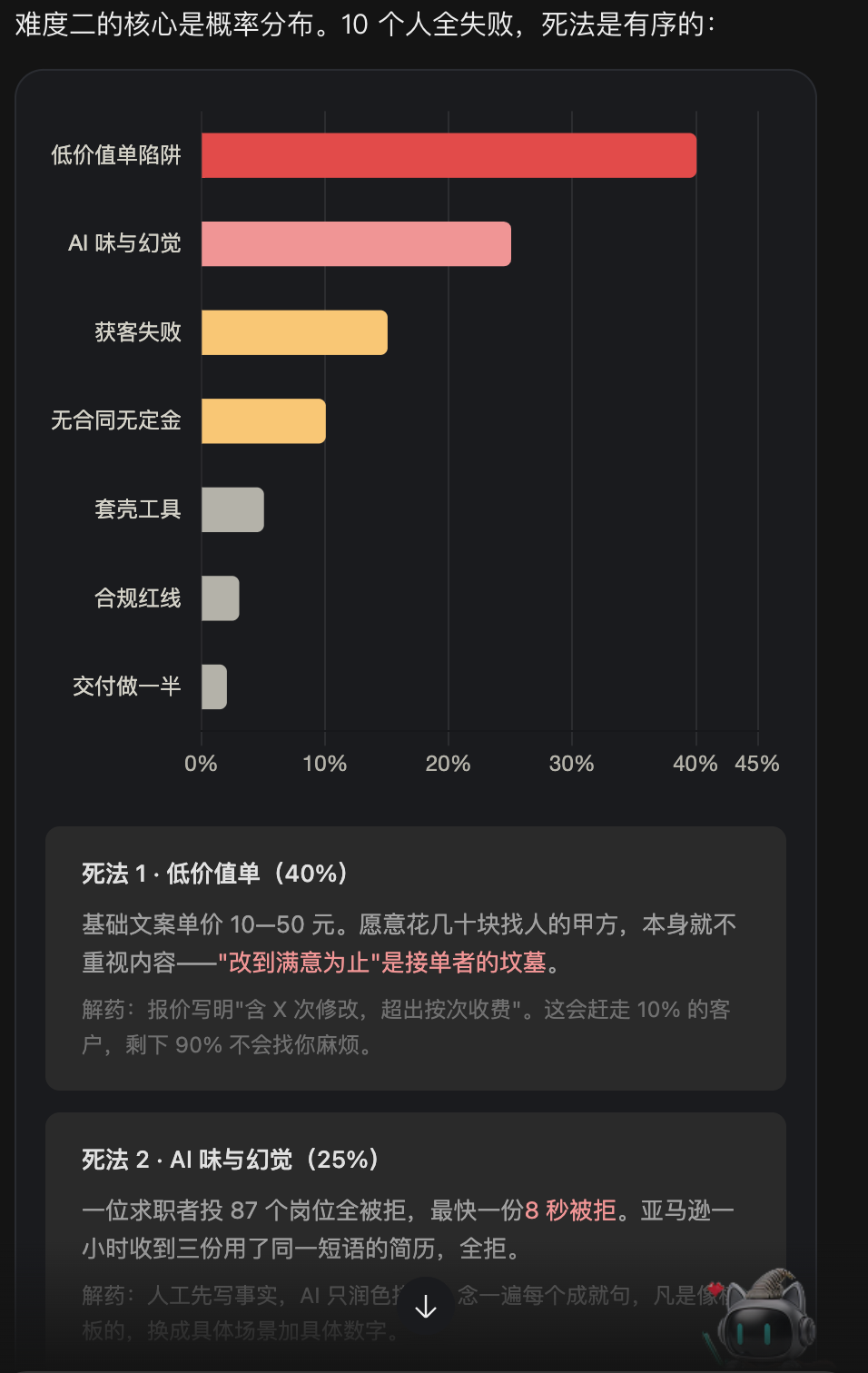
This time the answer made Aubzhang's back go cold.
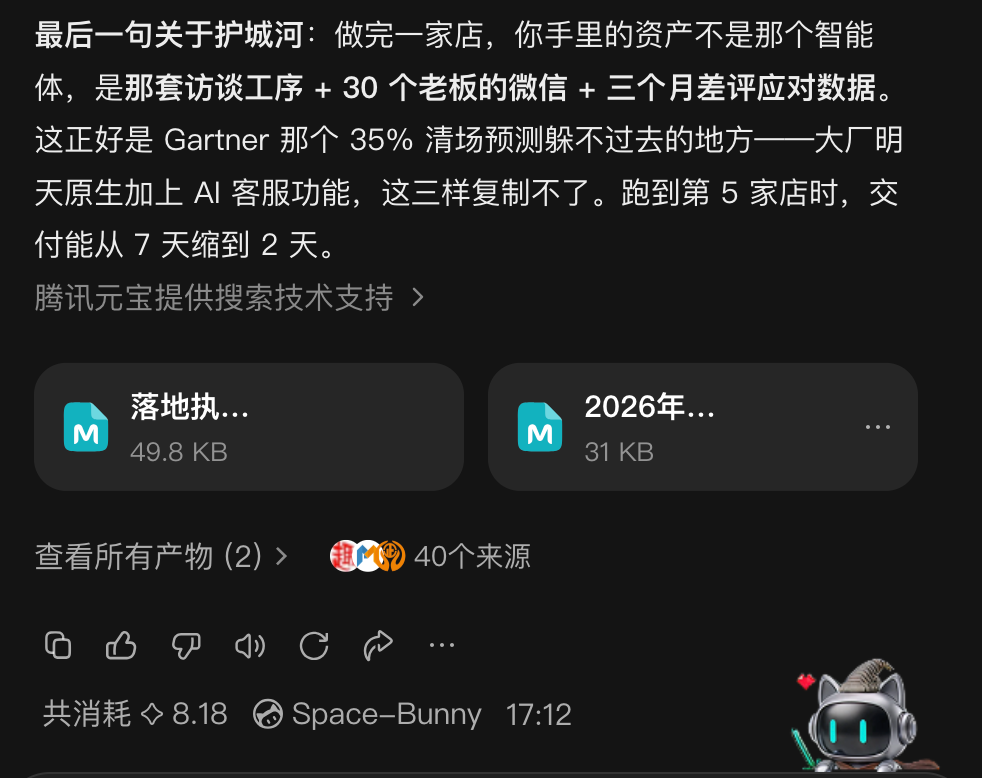
No motivational soup. It laid out a "ten ways to die" probability distribution: 40% die of "low-value orders" (endlessly revising resumes for a 39-yuan client); 25% die of "AI flavor and hallucination" (the AI-written resume gets auto-rejected in 8 seconds).
Better still, it gave exact scripts for walking storefronts, and even walked him through how to mine negative reviews of restaurant owners on Dianping, then take those reviews to sell them AI customer service.
This wasn't research anymore. This was a special-forces field manual.
Round Three: Asking AI for the Final Deliverable
Two rounds in: data secured, action guide secured. So Aubzhang pushed one last request:
"Please integrate the 'Market Research Report' and the 'Execution Landmine Map' you just produced into a formal research report document for readers. Requirements:
1. Clear structure: summary, pain points, directions, and the landmine map.
2. Render directly in HTML, with at least two extremely professional, minimal charts.
3. Export the integrated report as a complete PDF file I can download and share directly."
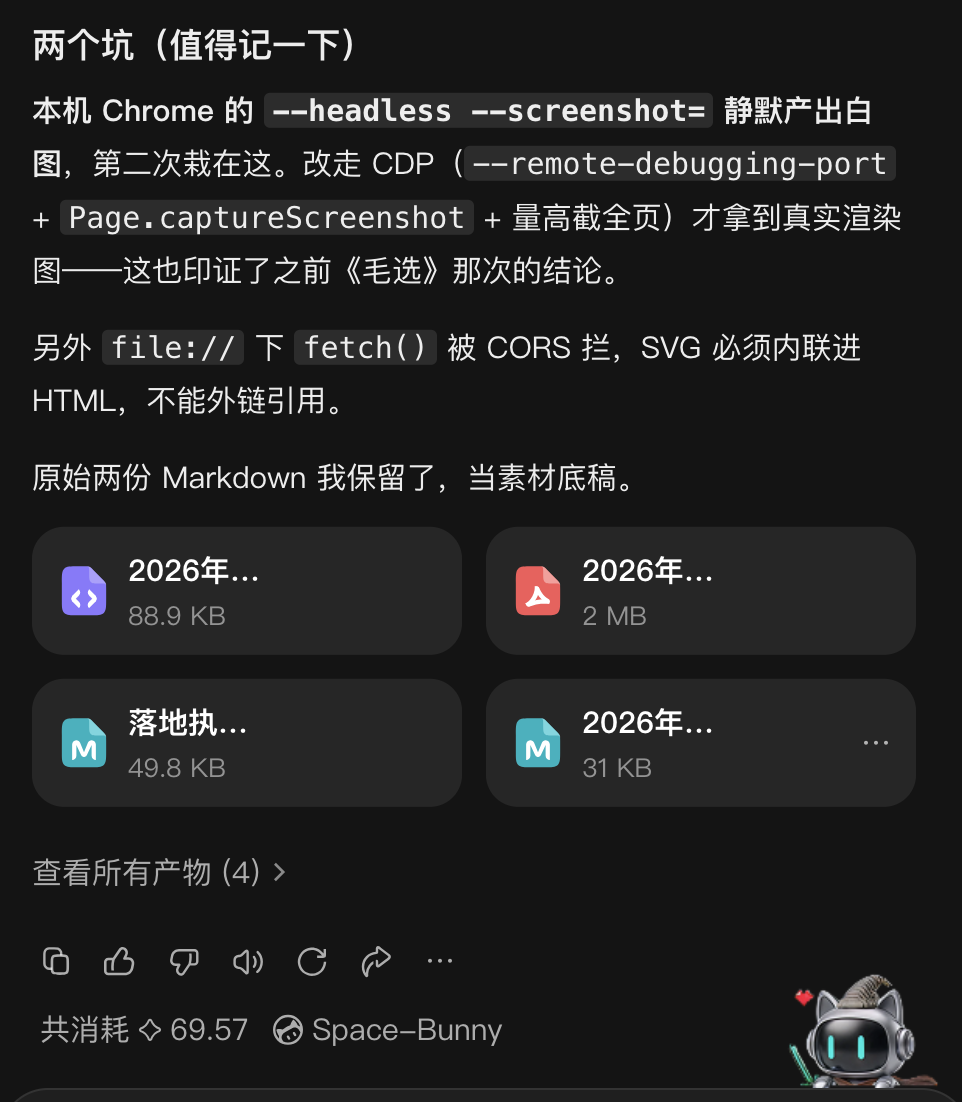
Minutes later, a 17-page PDF appeared in the chat — beautifully laid out, with inline SVG vector charts, a table of contents and page numbers.
Aubzhang looked at it and surrendered. This kind of deep industry research used to mean tens of thousands of yuan to a consulting firm. Now, if you understand the business and know how to give the right instructions, AI delivers it directly.
Aubzhang's Summary: So What Should Ordinary People Actually Do?
This report, Aubzhang has no intention of hoarding. Sharing all of it today.
Three brutal iron laws pulled out of it:
- Don't touch pure execution. In the AI era, "making it" is free. What sells is the responsibility and judgment you carry.
- The first mile is downstairs, not online. Stop fighting over 9.9-yuan gigs online. Walk the storefronts. Find the real pain.
- Either don't do it, or go deep. Take over the dirty, tedious work of one vertical (like a restaurant owner's negative-review management). That's the moat nobody can take from you.
The full 17-page PDF (with the complete chart set and action guide) is on Aubzhang's homepage.
To read the whole thing, search in your browser: aubzhang.com
(Note: WeChat may not open it directly. Copy the address into a browser.)
No courses, no fees. If you want to do something in 2026, Aubzhang hopes this report helps you dodge 80% of the pits.